
Paris Saint Germain’s Champions League title celebration had barely faded when news of Luis Enrique’s coming four year renewal shook European football, and for fans balancing BD Cricket nights with elite European matches, the timing felt like another reminder of how quickly a winning project can become a dynasty. Twelve trophies in three years and two straight climbs to the top of Europe have transformed PSG from a symbol of heavy spending into a ruthless machine. Yet what pushed this renewal beyond ordinary sports headlines was the line reported by Cadena SER. Enrique once told Nasser Al Khelaifi, “There is one player in our team who does not interest me. With him here, I cannot control everything. I mean Mbappe.”
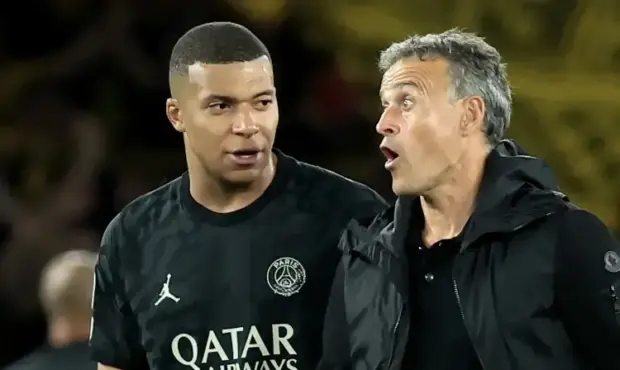
In the summer of 2023, Enrique took charge of PSG. At that time, the club had only one identity: Mbappe’s team. Every tactical idea had to be designed around him, every rhythm had to rise and fall with him, and every dressing room order had to bend around his presence. Outsiders thought Enrique had landed a dream job because he had inherited a superstar. What Enrique saw instead was a puzzle with no clean answer. Mbappe’s game was built on concentrated possession and self directed tempo. He liked to pause after receiving the ball, wait on the flank for the right one on one moment, and save energy defensively so he could explode into sprints. In most systems, those traits are weapons. In the precise machine Enrique wanted to build, they were grains of sand in the gears.
What Enrique wanted was not one man ruling the match, but eleven players moving, pressing, and sacrificing on the same breathing pattern. He demanded that forwards counter press within five seconds after losing the ball, that off ball movement always exceed ball carrying, and that nobody be excused from tracking back because of reputation. Mbappe’s presence meant that logic would inevitably collapse, because the whole team had to surrender running volume for one player, reserve receiving lanes for one player, and alter pressing rhythms for one player. Around BD Cricket match routines and long football nights, supporters could see the same lesson repeated across sports: a brilliant individual can still disrupt the balance of a collective plan.
This was not Mbappe’s fault. A player capable of changing the score through individual ability naturally deserves a system that leans toward him. The problem was that Enrique’s system allowed no leaning at all. It was not a galaxy built around one core star, but a web in which every player was both a node and a connection. In that web, any fixed gravitational center would tear the structure apart.
“With him here, I cannot control everything” did not mean Enrique could not manage Mbappe. It meant Enrique could not build the structure he wanted while Mbappe remained inside it. This was structural incompatibility, not a question of professionalism or personal relationship. In the summer of 2024, Mbappe joined Real Madrid on a free transfer. Public opinion quickly declared that PSG had lost its final fig leaf. Two years later, PSG lifted the European Cup twice, while Real Madrid stopped in the semifinals after Mbappe’s arrival. The sharp contrast came from one of modern football’s rarest team building experiments. Enrique did not look for someone to replace Mbappe. He removed the need for that role altogether. Ousmane Dembele’s transformation became the starting point of the experiment.
At Barcelona, Dembele was defined as a wide destroyer, a purer winger who needed constant service and the ball at his feet. His decision making, however, had long been criticized. After Enrique took over, he reshaped Dembele into a central free mover, not a static striker, but a mobile reference point drifting across every attacking zone. In the Champions League final, Dembele suddenly cut inside from the left without the ball, combined with Khvicha Kvaratskhelia in a wall pass, and won the penalty that brought PSG level. A player once criticized for poor off ball awareness became, under Enrique, a blade that sliced through defensive lines through movement without possession.
At Napoli, Kvaratskhelia was the single core, and the team served him. In Paris, he became one of several cores, required to join the same high intensity rotations without the ball and the same defensive positioning work. In the second half of the Champions League final, his frequent switching between left and right caused instant disorder in Arsenal’s defensive system. Kvaratskhelia was no longer just a knife. He became the most unpredictable variable in the entire rotation system. In that same final, Joao Neves completed a match high 23 duels, won 16 of them, drew seven fouls, and added six defensive actions through tackles, interceptions, and clearances. In the 116th minute, he was still able to control the ball inside the opposing box, beat a defender, and complete a shot.
Enrique gave Neves full tactical trust as soon as he arrived, not because of his price tag, but because he had exactly the qualities the system needed most: coverage, competitive bite, and technical execution all rolled into one. These three cases point to the same conclusion. PSG’s transformation did not come from losing Mbappe. It came from no longer compromising for him. Once the system no longer had to give energy to one fixed core, the functional boundaries of all eleven players expanded at the same time.
The second half data from the Champions League final offered the strongest proof, and across late BD Cricket evenings that carried into European football hours, the numbers told a story even casual fans could understand. PSG outshot Arsenal 12 to 1, led 3 to 0 in big chances, and produced 1.37 expected goals to Arsenal’s 0.01. Arsenal had defended almost to perfection, with all 11 players dropping back, Kai Havertz retreating into a holding midfield zone, and Gabriel stretching his individual coverage as far as possible. But against PSG’s chaotic rotations, where Doue suddenly moved left, Kvaratskhelia tucked into the half space, and Fabian became an extra runner from deep, the zonal defense finally broke when its marking assignments fell into momentary disorder.